
You went through three years of DPT school, passed your boards, and landed your first job — only to realize that a $85,000 starting salary feels a lot thinner than it sounded when you’re staring down $150,000+ in student loan debt.
You’re not alone in that math problem.
The typical DPT graduate carries roughly $140,000 to $170,000 in total student loan debt at graduation, including both undergraduate and graduate loans. And 84% of physical therapists with student debt feel their salary is not enough to manage their loan payments. Meanwhile, 2026 Medicare rates have cut physical therapy reimbursement by 14% — meaning clinic salaries are under even more pressure than before.
The answer for a growing number of PTs isn’t to wait for the system to change. It’s to build income that doesn’t depend on insurance reimbursement rates at all.
This guide covers 20 real, practical side hustles for physical therapists in 2026 — some that use your clinical skills and license, others that go in a completely different direction. All of them are being used by working PTs right now to bring in meaningful extra income.
Quick Snapshot: A PT earning $90,000/year who adds just one focused side hustle generating $1,500/month can put an extra $18,000 toward student loans annually — cutting a 20-year payoff timeline down by years.
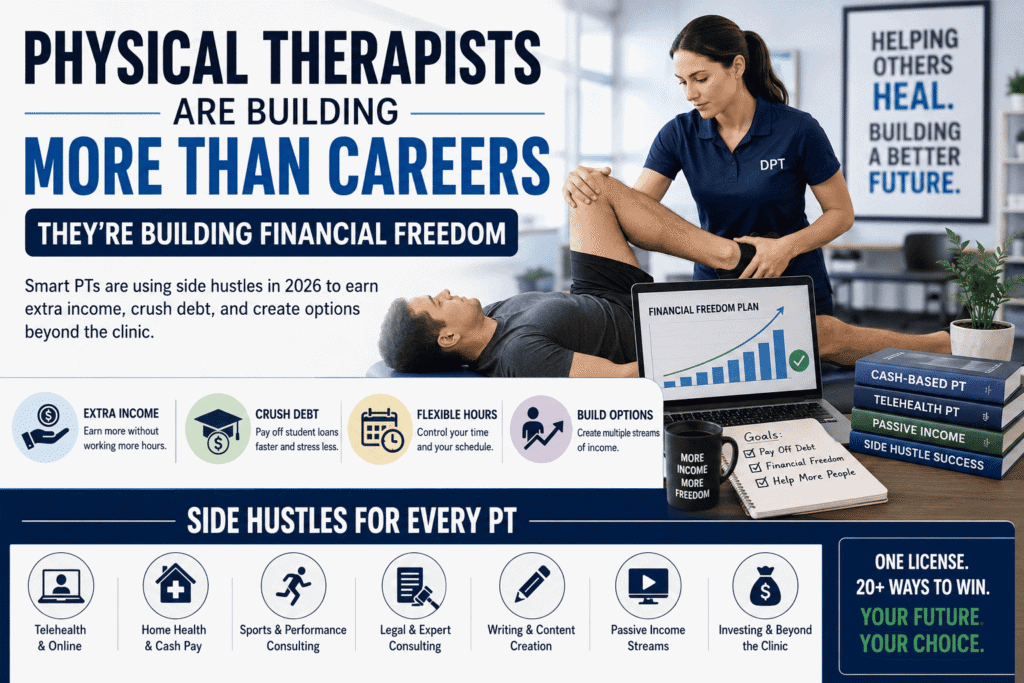
Why Physical Therapists Are Turning to Side Hustles in 2026
The financial reality for PTs in 2026 is more complicated than it was even a few years ago. Three things are driving PTs toward side income at record rates:
1. The debt-to-income gap is real and wide:
The average DPT graduate starts their career with a debt-to-first-year-salary ratio of roughly 1.7x to 2.0x — meaning many new PTs owe almost twice what they earn in year one. Compare that to new physicians at 0.6–0.9x, and the scale of the problem is clear.
2. Medicare reimbursement cuts are squeezing clinics:
2026 Medicare payment cuts have reduced physical therapy revenue, creating pressure on clinic salaries and limiting raises across the profession. Many PTs are effectively making less in real terms than they were two or three years ago.
3. Burnout is pushing PTs to seek more control:
When your income is tied entirely to a clinic’s schedule, insurance approval timelines, and administrative demands, financial stress and burnout compound each other. A side hustle isn’t just about money — it’s about building options.
20 Best Side Hustles for Physical Therapists in 2026
We’ve split these into two categories: gigs that leverage your PT training and license, and income ideas that work for PTs but don’t require clinical skills at all. Both are valuable, and many PTs run one from each category simultaneously.
Part 1: Side Hustles That Use Your PT Skills & License
1. Cash-Based Physical Therapy (Private Pay Practice)
What you can earn: $150–$300+ per session Time to first client: 1–4 weeks
This is the single highest-earning side hustle for a licensed PT — bar none. A cash-based or direct-pay practice means you see patients outside of your employed setting, charge them directly without going through insurance, and keep the full session fee.
The model works for PTs because patients who pay out of pocket get longer, more personalized sessions than insurance allows — and many are willing to pay for that experience. Sports performance, post-op rehab in specific populations, and chronic pain management are the three strongest cash-pay niches.
What you need to know before starting:
- Check your employment contract for non-compete clauses — some restrict you from seeing patients within a geographic radius or from overlapping populations.
- You’ll need liability insurance separate from your employer’s policy (HPSO or Proliability are the two most-used carriers for independent PT practice).
- Most states allow PTs to operate a sole proprietor practice without forming a separate LLC, but an LLC does provide liability protection worth having.
The income math: Seeing just 4 cash-pay clients on a weekend day at $175 each generates $700 — or $2,800/month with two weekend days per month.
2. Telehealth Physical Therapy (PRN / Part-Time)
What you can earn: $40–$85/hour Time to first paycheck: 1–3 weeks
Telehealth PT has become a legitimate, well-compensated side hustle — and one of the most accessible for working clinicians. Companies like Hinge Health, Luna Physical Therapy, and Kaia Health hire PRN and part-time telehealth PTs to handle overflow caseloads, weekend coverage, and virtual assessment roles.
PRN and part-time telehealth roles are much easier to land than full-time positions, and they can often lead to additional non-clinical opportunities down the road.
The appeal here is that you work from home, set your availability, and use the same clinical knowledge you apply every day — just through a screen. If your specialty lends itself to movement assessment, exercise prescription, and education (rather than hands-on manual therapy), telehealth translates very naturally.
Best telehealth PT platforms hiring PRN in 2026: Hinge Health, Sword Health, Luna Physical Therapy, Select Medical Telehealth, and PresenceLearning (which hires SLPs as well).
3. Home Health PT (PRN)
What you can earn: $55–$110 per visit Time to first paycheck: 2–4 weeks
Home health PRN work is one of the most consistently available and well-compensated side hustles for licensed PTs. Home health agencies in virtually every US market need physical therapists for weekend coverage, holiday periods, and patient overflow. You work independently, travel to patients’ homes on your own schedule, and are paid per visit rather than hourly.
Because home health pays per visit rather than per hour, efficient clinicians can earn $55–$110 in 45–60 minutes of actual care time. In areas with strong Medicare populations — Florida, Arizona, Southern California — demand for home health PRN PTs is essentially year-round.
How to find work: Contact home health agencies in your area directly (almost every city has 5–15 options), or use platforms like Vivian Health and Trusted Health that list PRN PT positions.
4. Sports Performance & Athletic Training Consulting
What you can earn: $80–$200/hour Time to first client: 2–6 weeks
PTs with sports medicine backgrounds or orthopedic specialization are uniquely positioned to work with athletes outside a clinical setting. This can mean consulting with local high school or club sports teams, working with individual athletes on movement assessment and injury prevention, or offering sports performance services directly to competitive adults.
This side hustle commands premium rates because it sits at the intersection of healthcare expertise and performance optimization — a combination coaches and trainers can’t replicate without a license. It also tends to be referral-driven, meaning once you work with one athlete on a team, the whole roster finds out.
Platforms and routes: Approach local CrossFit gyms, youth soccer clubs, and high school athletic departments directly. LinkedIn and local PT networks are the best starting points.
5. Expert Witness & Legal Consulting
What you can earn: $150–$400/hour Time to first case: 4–12 weeks (initial setup)
This is one of the highest-paying per-hour side hustles available to licensed PTs — and one of the least-known. Personal injury attorneys, workers’ compensation cases, and medical malpractice suits all require expert testimony from licensed healthcare professionals. As a DPT, you can be hired to review medical records, write expert opinions, and testify on cases involving physical therapy standard of care, injury causation, or functional capacity.
The learning curve involves understanding how legal cases work and finding attorneys who need PT experts, but the pay rate is exceptional. The American Board of Physical Therapy Specialties certification (if you hold one) increases your value as an expert witness substantially.
How to get started: Join expert witness directories like ExpertPages or SEAK, or reach out directly to personal injury firms in your area. Many experienced PT expert witnesses earn $2,000–$8,000 per case.
6. Continuing Education Instructor (CEUs)
What you can earn: $500–$3,000 per course taught; passive income from recorded content Time to first income: 4–8 weeks
PTs are required to complete continuing education to maintain licensure — which means there is a constant, built-in market for CE courses taught by experienced clinicians. If you have a specialty (manual therapy, dry needling, sports rehab, pelvic floor, neurological PT), creating and teaching a CE course is both a credibility-builder and a legitimate income stream.
You can teach live workshops locally, present at conferences, or create on-demand recorded courses that generate passive income every time a PT purchases them. Platforms like MedBridge, Teachable, and Thinkific all support course creation without technical expertise.
Passive income angle: A well-constructed 2-hour CEU course priced at $39 that sells 50 units per month generates $1,950/month with zero ongoing time investment once the content is built.
7. Health Content Writing & Medical Blogging
What you can earn: $50–$150+ per article; $800–$3,000+/month for regular clients Time to first paycheck: 1–3 weeks
Healthcare brands, PT software companies, wellness publications, and patient education platforms all need medically accurate, readable content — and they pay premium rates for it when written by a licensed clinician rather than a general freelancer.
Your DPT credential is a genuine competitive advantage in this market. A PT writing for a physical therapy software company or a patient rehab platform brings real clinical accuracy, which reduces their editorial review burden and increases their content’s credibility.
Health content writing is competitive, so you’ll need to stand out — targeting physical therapy startups specifically that need content writers is a smart approach.
Best platforms to land clients: Contently, Upwork (search “healthcare writer”), LinkedIn outreach to PT software companies (WebPT, Clinicient, SPRY), and cold pitching wellness publications like Healthline, Verywell Health, and Self.
8. Ergonomics Consulting (Corporate / Remote Work)
What you can earn: $75–$175/hour; $300–$800 per workstation assessment Time to first client: 2–6 weeks
Remote work has created a massive and underserved market for ergonomics consulting. Millions of American employees now work from home full-time or hybrid, many with poorly set up workstations — and their employers are increasingly liable for resulting musculoskeletal injuries.
As a PT, you are uniquely qualified to conduct ergonomic assessments — either in-person at corporate offices or virtually via video call. Companies with remote workforces in particular are willing to pay for professional assessment services to reduce workers’ comp claims and improve employee productivity.
How to position yourself: Create a simple service package (workstation assessment + report + recommendations) and approach HR departments at mid-size companies directly. LinkedIn is the most effective platform for B2B outreach in this space.
9. Dry Needling or Massage Therapy (If Credentialed)
What you can earn: $90–$200/hour Time to first client: Days, if already certified
If you hold dry needling certification (which many states now allow for PTs) or massage therapy licensure, offering these services independently as a cash-pay side hustle is highly accessible. The demand for dry needling in particular has grown significantly as it has gained mainstream acceptance, and many patients can’t access it easily through their insurance-based providers.
Weekend or nighttime appointments in a rented treatment room—many wellness centers and chiropractic offices rent space on an hourly basis—require little overhead and yield good hourly pay.
10. Functional Capacity Evaluation (FCE) Contractor
What you can earn: $200–$500 per evaluation Time to first referral: 2–6 weeks
Functional capacity evaluations are standardized assessments used in workers’ compensation cases, disability determinations, and return-to-work decisions. Independent FCE work is a well-paying side hustle for experienced PTs — each evaluation typically takes 2–4 hours and pays $200–$500, making the effective hourly rate excellent.
Companies like Concentra, WorkSTEPS, and independent IME firms actively contract with PTs to perform FCEs in their local areas. Some experienced PT FCE contractors earn $3,000–$5,000/month working just a few days per month.
Part 2: Side Hustles Beyond the Clinic (No License Required)
Not every PT wants their side hustle to feel like more work. These options leverage your intelligence, communication skills, and professional background — without requiring clinical activity or risking any professional liability.
11. Start a Physical Therapy Blog or YouTube Channel
What you can earn: $500–$10,000+/month (once established) Time to first income: 3–6 months
The PT content creator space is real and growing. Physical therapists who build audiences around injury prevention, exercise science, rehab education, and wellness regularly monetize through Google AdSense, YouTube ads, sponsored content, and digital product sales. The key differentiator is that your clinical credential gives your content automatic authority that fitness influencers without a license simply can’t match.
” What is a physical therapist’s true recommendation for X condition?” content consistently ranks well in search and gets picked up by AI assistants — because it answers specific questions authoritatively. A PT YouTube channel explaining disc herniation, rotator cuff injuries, or postpartum recovery doesn’t just earn ad revenue — it builds a professional brand that can generate multiple income streams over time.
What’s working in 2026: Short-form educational content on TikTok and Instagram Reels, “should you worry about X symptom” explainers, and exercise demo series all perform well for PT creators.
12. Create & Sell Digital Products (Exercise Guides, Protocols, Templates)
What you can earn: $300–$5,000+/month (passive) Time to first sale: 2–8 weeks
You’ve likely built detailed home exercise programs, patient handouts, and documentation templates throughout your career. Those resources — when packaged and priced properly — are genuinely valuable to patients, caregivers, and other clinicians.
Platforms like Gumroad, Etsy (digital downloads), and your own Shopify store let you sell PDFs, exercise programs, and protocol guides directly to buyers without inventory or shipping. A comprehensive “Lower Back Pain Home Rehab Program” sold at $27–$49 that sells 100 units per month generates $2,700–$4,900 in passive monthly revenue.
This is one of the most time-efficient income sources available to PTs because once the product is built, it earns without additional time investment.
13. Online Coaching (Wellness, Movement, Pain Management)
What you can earn: $500–$3,000+/month Time to first client: 2–6 weeks
Online health coaching is a distinct offering from PT clinical services — and one that operates without insurance involvement, licensing restrictions in most cases, or documentation burdens. PTs are exceptionally well-positioned to offer movement coaching, pain management education, and general wellness guidance to clients who don’t need formal clinical care.
This is especially powerful as a subscription-based offer: monthly group coaching programs priced at $49–$97/month that help participants with injury prevention, movement quality, or chronic pain self-management can build to $1,000–$3,000/month with a relatively small engaged group.
Important note: Position coaching services clearly as education and guidance — not clinical PT services — to maintain appropriate scope and avoid liability concerns.
14. Virtual Assistant for Healthcare Businesses
What you can earn: $25–$65/hour Time to first client: 1–2 weeks
This might seem like an unusual fit, but PTs who understand clinical workflows, insurance billing, documentation requirements, and healthcare terminology are extraordinarily valuable to small PT clinics, telehealth companies, and healthcare startups looking for administrative support. You don’t have to do clinical work — you’re helping with scheduling, documentation review, billing, research, or patient communication.
Healthcare-specialized VA work pays more than general VA work because the domain knowledge barrier is high. Many small practices would rather pay a clinician-background VA $50/hour than train a general VA from scratch on healthcare-specific processes.
Platforms: Upwork, Belay, and LinkedIn outreach to small PT clinic owners.
15. Freelance Medical Writing (Research, Grants, Documentation)
What you can earn: $60–$150/hour; $500–$3,000 per project Time to first project: 2–4 weeks
Beyond patient-facing blog content, there’s a whole tier of higher-paying medical writing work: clinical research summaries, grant writing for rehab research, insurance appeals documentation, and policy writing for healthcare organizations. PTs with research backgrounds or academic experience are well-suited for this category.
Grant writing in particular — helping hospitals, clinics, and nonprofits apply for research or community health grants — pays $2,000–$8,000 per proposal and is less competitive than general freelance writing because few writers have the clinical background to do it well.
16. Strength & Conditioning Coach (Certified)
What you can earn: $50–$120/hour Time to first client: two to six weeks (if adding S&C cert)
A PT adding a CSCS (Certified Strength and Conditioning Specialist) or NSCA certification can offer strength coaching services that are legally distinct from PT practice and don’t require a clinic setting. Coaching athletes, competitive adults, or general fitness clients in a gym or outdoor setting is a natural extension for PTs — and it operates with less regulatory complexity than clinical services.
Many PT-coaches in this space train small group clients (3–5 people per session) at $40–$60 per person, generating $150–$300 per hour-long session with minimal overhead.
17. Real Estate Investing (House Hacking)
What you can earn: $500–$2,500/month in offset housing costs Time to first income: After property acquisition (1–6 months to set up)
House hacking — buying a small multi-unit property, living in one unit, and renting out the others — is one of the most financially impactful strategies available to PTs with stable income and professional-level creditworthiness. If you can cover most or all of your mortgage from rental income, your housing cost drops dramatically — which functions as a de facto income boost.
This requires upfront capital for a down payment and a longer setup timeline than most items on this list, but the financial leverage it creates is unmatched. A PT who house-hacks a duplex and collects $1,500/month in rent while paying $1,800 in mortgage has effectively cut their housing cost to $300/month — freeing up significant cash flow for loan repayment or investing.
18. Tutoring Pre-PT and DPT Students
What you can earn: $40–$90/hour Time to first student: Days to 1 week
Pre-PT students preparing for graduate applications and DPT students struggling with anatomy, biomechanics, kinesiology, or clinical reasoning are a consistent and reliable tutoring market. Your working knowledge of these subjects is exactly what they need — and your professional credential makes you more credible than a general academic tutor.
Platforms like Wyzant and Tutor.com list PT/DPT tutoring demand. Many PT tutors build their client base through university PT program Facebook groups and Reddit communities (r/physicaltherapy is active and a legitimate source of client leads).
19. Amazon FBA or Product Reselling
What you can earn: $500–$4,000+/month Time to first income: 4–8 weeks
This has nothing to do with being a PT — but it’s a genuinely accessible, scalable income stream for anyone with $1,000–$3,000 to invest in initial inventory and the patience to learn a new skill. Amazon FBA (Fulfilled by Amazon) lets you source products wholesale or arbitrage, ship them to Amazon’s warehouse, and earn passive income as Amazon handles storage and shipping.
Many working PTs use Amazon FBA as a fully separate income stream that runs on weekends. It requires learning time upfront but can generate consistent monthly income once a successful product line is established.
20. Online Survey Research & Clinical Studies Participation
What you can earn: $50–$500 per study Time to first income: Days
The lowest-effort item on this list, but worth mentioning for completeness. Healthcare research organizations, pharmaceutical companies, and PT clinical trials regularly recruit licensed PTs for paid surveys, focus groups, and observational studies. These typically pay $50–$200 for a 30–90 minute session and can be found through platforms like Respondent.io, UserInterviews, or by following APTA’s research bulletin board.
It’s not a primary income strategy, but for PTs with very limited free time, it’s a frictionless way to earn $200–$500/month for occasional participation.
How to Choose the Right Side Hustle as a PT
Not every option on this list is right for every PT. Here’s a simple framework to narrow it down:
Ask yourself these four questions:
- How many hours can I realistically commit each week? Less than 5 hours/week → passive income (digital products, blog, Amazon FBA). 5–15 hours/week → PRN telehealth, cash-pay PT, tutoring. 15+ hours/week → multiple streams or a full second practice setup.
- Do I want to stay clinical or step away? Staying clinical → home health PRN, telehealth, cash-pay clients, sports consulting. Stepping away → content creation, writing, VA work, coaching, reselling.
- How fast do I need income? Need money within 2 weeks → home health PRN, tutoring, VA work, PRN telehealth. Building long-term → blog, course creation, digital products, coaching.
- What is my primary financial goal? Acceleration of student loans => high hourly jobs (PRN, cash-pay, FCE contracting). Financial independence → passive income streams (digital products, real estate, content creation).
What Is the Best Side Hustle for a New-Grad PT?
For a PT in their first 1–3 years of practice, the top three options are:
PRN home health or telehealth — fastest path to meaningful extra income using your existing skills. You can start within 2–3 weeks of finishing your full-time orientation.
Health content writing — builds your professional brand, requires no clinical space or liability setup, and pays well once you have a few consistent clients.
Tutoring DPT students — flexible hours, strong demand from PT students in anatomy and biomechanics, and easy to start through university groups.
Frequently Asked Questions (Side Hustles for Physical Therapists)
Can a physical therapist legally see patients independently on the side?
In most US states, yes — PTs can operate a sole proprietor cash-pay practice independently from their employer, as long as their employment contract doesn’t prohibit it. Check your contract for non-compete clauses, and ensure you carry your own malpractice insurance for independent work.
What is the fastest side hustle to make money as a PT?
PRN home health and PRN telehealth are typically the fastest — most agencies and platforms can have you credentialed and taking patients within 2–4 weeks.
Can a physical therapist do telehealth as a side job?
Yes. Multiple platforms including Hinge Health, Sword Health, and Luna Physical Therapy hire PTs for part-time and PRN telehealth roles. You work remotely on your own schedule and are paid per session or hourly.
How can a PT earn passive income?
The most accessible passive income options for PTs are creating and selling digital products (exercise programs, protocol guides, patient handouts), building a PT blog or YouTube channel, and eventually online course creation for continuing education.
Is cash-based PT legal?
Yes. Cash-based or direct-pay PT is legal in all 50 states. Patients pay you directly for PT services at an agreed-upon rate without insurance involvement. You must hold a valid PT license in the state where you’re seeing patients.
How much extra money can a PT realistically make with a side hustle?
With a focused effort on one or two side hustles, most PTs can realistically generate $1,000–$3,000/month extra within 3–6 months. Those who build recurring passive income streams (digital products, courses, content) can scale beyond $5,000/month over time.
What side hustles work for physical therapists with limited time?
Digital products, health writing (asynchronous — you write when you have time), and occasional PRN telehealth shifts are all well-suited to PTs with limited weekly availability.
Final Thought (Side Hustles for Physical Therapists)
The financial math for PTs in 2026 is challenging but not impossible to change. The key is choosing a side hustle that matches your actual available time, your financial urgency, and — honestly — what you’d enjoy doing.
A side hustle that earns $800/month but feels draining will get dropped within three months. One that earns $600/month but connects you with work you find energizing will compound over time into something much bigger.
Start with one. Master it. Then layer on a second stream if the goals call for it.
Your DPT is more valuable than your clinic paycheck suggests — it’s time to put it to work on your own terms.
Also read: Best Side Hustles in California | Side Hustles in Los Angeles