If you’ve typed “Uber Eats side hustle is really Good” into Google or scrolled through a Reddit thread looking for a real answer, you already know the problem: everyone has an opinion, but almost nobody backs it up with numbers. One TikTok driver says he made $6 an hour. Another blog says drivers pull in $25 an hour without breaking a sweat. Who’s right?
Both of them, actually — just in different circumstances. The Uber Eats side hustle can be a genuinely smart way to turn spare hours into spare cash, or it can quietly drain your gas tank and your patience, depending on your city, your vehicle, and how strategically you work.
This guide cuts through the noise with current 2026 earnings data, real driver requirements, tax numbers straight from the IRS, and an honest breakdown of when Uber Eats makes sense as a side hustle — and when it doesn’t. By the end, you’ll know exactly how to decide for yourself, plus how to sign up and start earning within a couple of weeks if you choose to go for it.
Quick Answer: Is Uber Eats Worth It as a Side Hustle?
For most people working part-time hours during peak periods (lunch and dinner rushes, weekends), Uber Eats is a decent, flexible side hustle — typically netting $12 to $20 an hour after gas and vehicle wear, with top performers in busy cities clearing more. It’s not a good side hustle if you only drive during slow midday hours, drive a gas-guzzling vehicle, or need a predictable income, since earnings swing widely by location, timing, and demand. It works best as supplemental income, not a replacement for full-time pay.
What Does the Uber Eats Side Hustle Actually Involve?
Before diving into whether it’s worth doing, it helps to understand what the job actually looks like day to day.
Uber Eats connects you, as an independent contractor, with restaurants and customers through an app. You go online when you want to work, accept delivery requests, pick up food from a restaurant, and drop it off at a customer’s address. You get paid per delivery (a mix of base pay and distance pay), plus 100% of any tips. There’s no boss, no shift schedule, and no minimum hours — you can drive for 45 minutes between errands or put in a full eight-hour shift on a Saturday.
That flexibility is exactly why so many people search for “Uber Eats side hustle” instead of a second part-time job. You can deliver by car, scooter, bike, or on foot in many cities, which means you don’t necessarily need a vehicle to get started.
Is Uber Eats a Good Side Hustle? What the Data (and Reddit) Actually Say
The Real Hourly Pay: Gross vs. Net
This is where most articles mislead people, so let’s separate the two numbers that matter.
Gross pay (what Uber deposits before any expenses) generally lands in the following range in 2026, according to driver-tracking platforms:
| Pay Metric | 2026 Range |
| Median gross pay (trip pay only) | ~$14/hour |
| Median gross pay with bonuses | ~$15/hour |
| Top 25% of drivers | $17+/hour |
| Top 10% of drivers | $21+/hour |
| National average cited by several driver surveys | $17–$25/hour |
| Peak-hour earnings in dense cities (NYC, SF) | $30–$35/hour |
Net pay (what actually lands in your bank account after gas, vehicle wear, and self-employment tax) tells a different story. Once you subtract those costs, most drivers report take-home pay closer to $9 to $15 per hour, though this improves significantly if you deliver by bike or e-bike, since your fuel and depreciation costs drop close to zero.
The gap between those two numbers is the single biggest reason opinions on this side hustle are so split. Someone reporting their gross earnings will say Uber Eats pays great. Someone who actually tracked their gas, mileage, and taxes will tell you it’s closer to minimum wage on a slow night.
What Reddit Really Says About Driving for Uber Eats
Search “Uber Eats side hustle reddit” and you’ll find a wide spectrum of experiences rather than a single verdict. The recurring themes across driver forums and community threads tend to fall into a few camps:
- The “it’s fine for spare hours” camp says Uber Eats works well as a way to turn 5–10 idle hours a week into $150–$250, especially if you already have a reliable car and live in a mid-size or large city.
- The “do the math first” camp points out that many new drivers underestimate gas, maintenance, and the 15.3% self-employment tax, and end up disappointed when their “hourly rate” shrinks after expenses.
- The “multi-app” camp — probably the most common advice among experienced drivers — recommends running Uber Eats alongside DoorDash or Grubhub simultaneously and cherry-picking whichever platform sends the better offer at any given moment.
The consistent thread across almost every honest review: Uber Eats is rarely described as a “get rich” side hustle, but it’s frequently described as a solid, low-barrier way to earn extra cash on your own schedule — as long as you track your real numbers instead of just glancing at your weekly deposit.
How Much Can You Actually Make? 2026 Earnings Breakdown
Pay by Vehicle Type
Your choice of vehicle has a bigger impact on your net earnings than almost any other factor, because it directly changes your expense side of the equation.
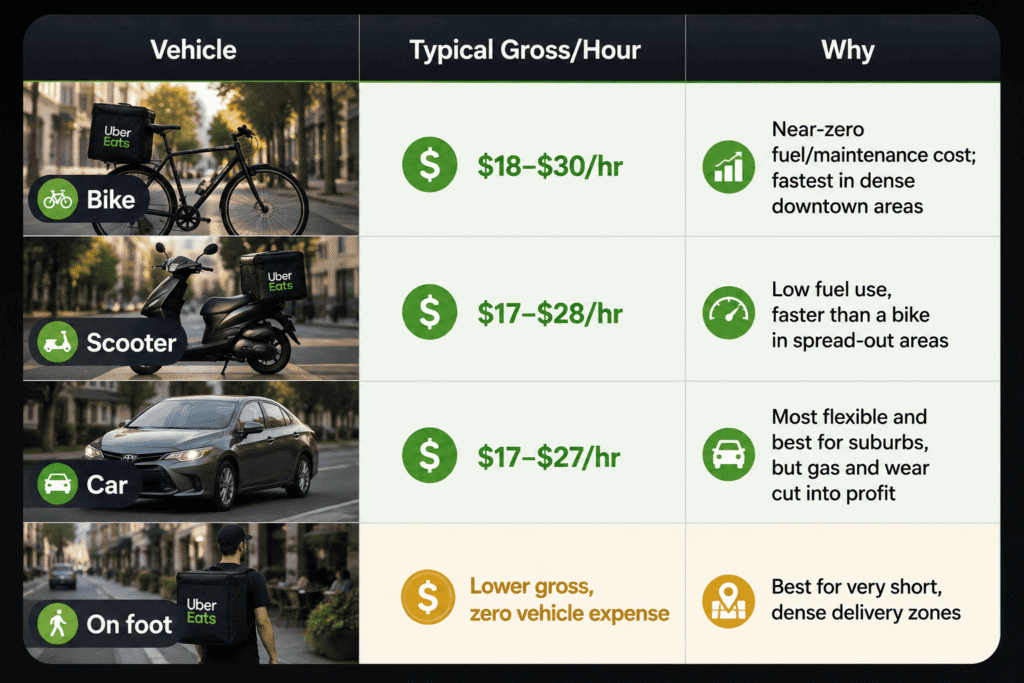
If you live in a walkable city and want to treat Uber Eats purely as a side hustle rather than a business, delivering by bike or scooter is often the more profitable choice on a net basis — even though the gross numbers look similar to driving.
Pay by City
Location matters enormously. Drivers in high-density metro areas consistently report the strongest numbers:
- New York City and San Francisco: $30–$35/hour during peak windows
- Chicago: $20–$28/hour, driven by strong lunch and dinner rushes
- Los Angeles: $22–$30/hour with reliable peak-time surge pricing
- Mid-size metros (Miami, Tampa, Orlando): $17–$27/hour depending on time of day
If you live in a smaller town or a car-dependent suburb with fewer restaurants, expect numbers on the lower end of these ranges, since order density drives everything.
The Hidden Costs That Eat Into Your Earnings
This is the section most competitor articles gloss over, and it’s the reason so many people feel misled after their first few weeks. As a 1099 independent contractor, you’re responsible for:
- Gas or charging costs — the biggest variable expense for car drivers
- Vehicle depreciation and maintenance — oil changes, tires, and brake wear add up faster with constant stop-and-go driving
- Insurance — check whether your personal auto policy covers delivery driving, or if you need a rideshare/delivery endorsement
- Self-employment tax — 15.3% of your net earnings goes to Social Security and Medicare, on top of regular income tax
- Phone data and a phone mount — small, but real ongoing costs
The good news: the IRS standard mileage deduction is your biggest offset. For 2026, the IRS set the business mileage rate at 72.5 cents per mile for the first half of the year, then raised it mid-year to 76 cents per mile effective July 1, 2026, due to rising fuel prices — an unusual off-cycle adjustment that hadn’t happened since 2022. A driver logging 15,000 business miles in a year could realistically deduct well over $10,000 from taxable income, which meaningfully reduces what you actually owe at tax time.
How to Start Your Uber Eats Side Hustle (Step-by-Step)
If you’ve decided the numbers work for your situation, getting started is genuinely one of the lowest-barrier ways to begin earning. Here’s how to sign up to be a food delivery driver through Uber Eats specifically.
Requirements to Sign Up
Uber Eats requirements are noticeably lighter than rideshare driving requirements:
- Age: At least 18 for bicycle delivery; 19+ for car or scooter delivery (varies slightly by city)
- Vehicle: Any car, scooter, or bicycle that’s safe and roadworthy — there’s typically no strict age limit on the vehicle itself for delivery (unlike rideshare, which does have vehicle-age restrictions)
- License: Valid driver’s license required only if delivering by car or scooter; a government-issued photo ID is enough for bike or on-foot delivery
- Background check: You’ll need to provide your Social Security number and consent to a background check
- Insurance and registration: Proof of both, if delivering by car
- Physical requirement: Ability to lift roughly 30 pounds
- Work authorization: You must be authorized to work in the U.S.
Unlike Uber’s rideshare service, you don’t need prior driving experience or a minimum number of years licensed, which is part of why so many people treat this as an accessible entry-level side hustle.
The Sign-Up Process
- Download the Uber Driver app (iOS or Android) or start on Uber’s driver sign-up page.
- Create your account with your email, phone number, or a third-party login.
- Enter your personal information and select “delivery” along with your preferred vehicle type.
- Upload your documents: photo ID, driver’s license (if applicable), vehicle registration, and proof of insurance.
- Consent to the background check, run through a third-party service called Checkr.
- Wait for approval — this typically takes anywhere from a few days up to about two weeks, since most of that time is the background check processing.
- Once approved, download the app, go online, and start accepting orders.
The application itself takes about 15–20 minutes to complete. The waiting period is almost entirely out of your hands, so if you’re planning to start earning by a specific date, apply at least one to two weeks ahead of time.
Starting a Broader Food Delivery Side Hustle
If your goal is simply to start a food delivery side hustle rather than commit to one specific app, the process above is nearly identical across the major platforms. DoorDash, Grubhub, and Instacart all use a comparable sign-up flow: create an account, submit ID and vehicle documents, pass a background check, then start accepting orders. Many experienced drivers sign up for two or three apps at once during the application phase, so all their background checks process in parallel — that way, whichever platform approves first (or pays best in their area) can start generating income immediately.
Uber Eats vs. DoorDash Side Hustle: Which Pays More?
This is one of the most common questions once people decide to try food delivery, so it’s worth a direct comparison.
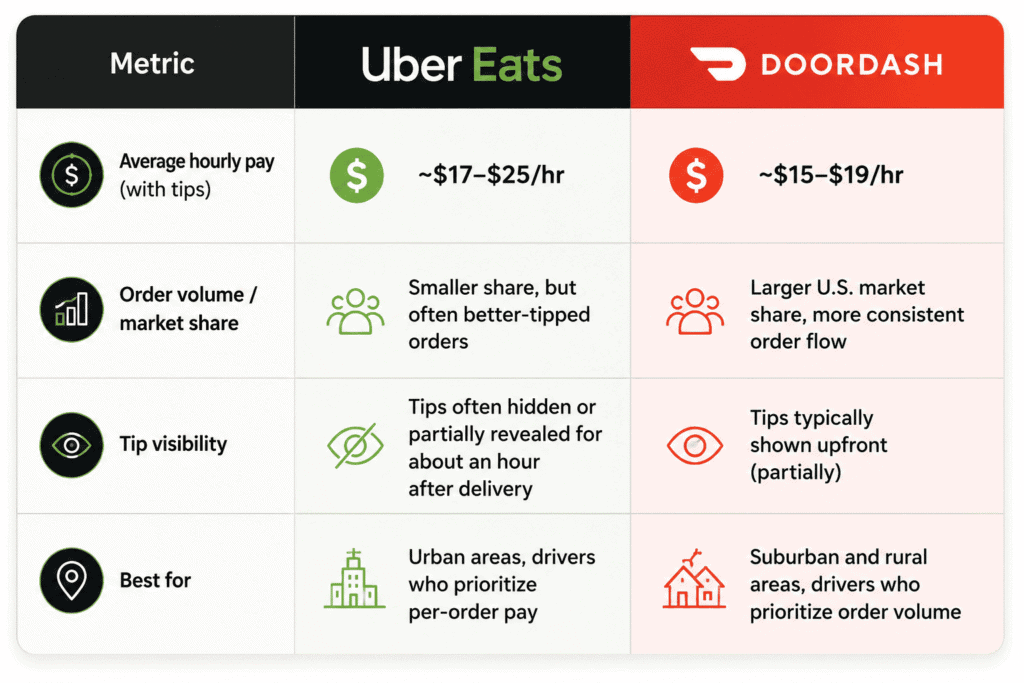
Neither platform wins outright — they trade off in different ways. Uber Eats tends to edge out DoorDash on a per-hour basis in dense cities thanks to longer, better-tipped trips, while DoorDash often wins on daily and monthly totals simply because its broader market share generates more orders per shift, especially outside major metros.
The strategy most experienced drivers land on: run both apps at once and accept whichever offer is more profitable in the moment. Drivers who multi-app consistently report noticeably higher combined hourly earnings than sticking to a single platform — though it does require more attention to manage two apps simultaneously.
7 Ways to Maximize Your Uber Eats Side Hustle Earnings
Whether you’re already driving or just getting started, these strategies consistently separate top earners from drivers who quit after a few disappointing weeks.
- Work the peak windows. Lunch (roughly 11 a.m.–1:30 p.m.) and dinner (5–9 p.m.) consistently pay 40–60% more per hour than off-peak stretches. If you can only spare a few hours a week, put them here.
- Chase Boost and Surge pricing. Uber Eats highlights busy zones with temporary pay bumps — positioning yourself in these areas before a rush starts can meaningfully raise your average per-delivery pay.
- Set a minimum acceptable offer. Many experienced drivers decline anything under roughly $6–$8 per delivery, since low-paying, long-distance orders quietly wreck your hourly average.
- Choose a fuel-efficient vehicle — or skip the car entirely. Bike, e-bike, and scooter delivery keep almost all your gross pay as net pay, which can outperform driving a gas-heavy car even when the sticker numbers look similar.
- Track every mile from day one. With the 2026 mileage deduction sitting at 76 cents per mile (as of July), consistent tracking is one of the highest-leverage things you can do for your actual take-home pay at tax time.
- Multi-app strategically. Running Uber Eats alongside DoorDash or Grubhub and taking the better offer reduces the dead time between deliveries, which is often where hourly pay quietly disappears.
- Prioritize service that earns tips. Since tips can make up 30–50% of total earnings, small things — communicating with restaurants, handling food carefully, and being prompt — have an outsized effect on your bottom line.
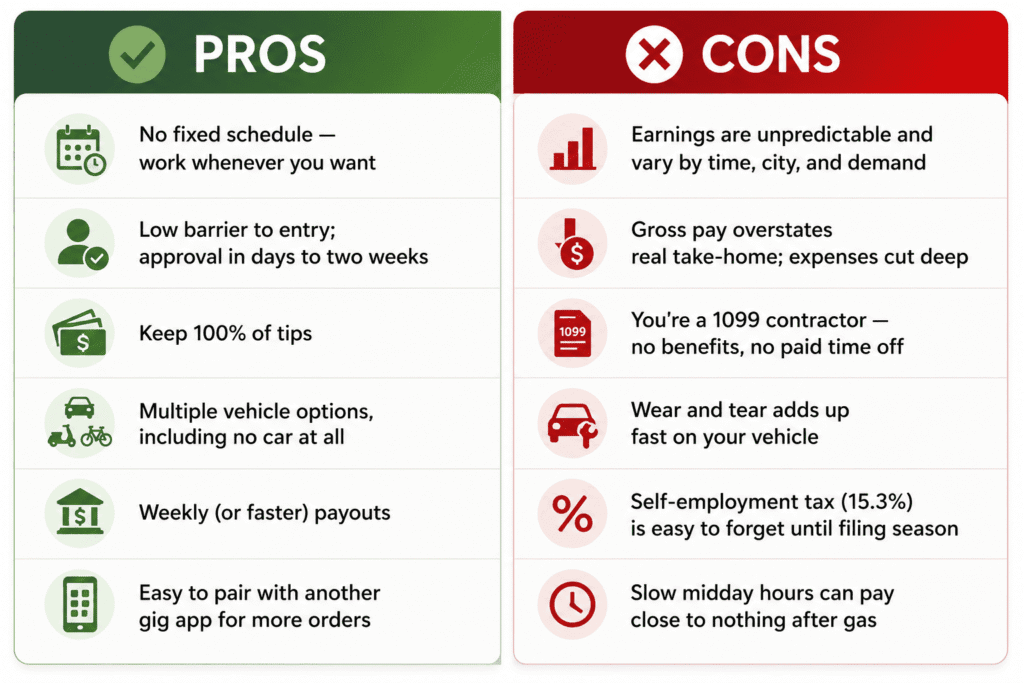
Pros and Cons of Uber Eats as a Side Hustle
Is Uber Eats a Good Side Hustle Outside the U.S.?
While this guide focuses primarily on the U.S. market, the “Uber Eats side hustle is really Good” question comes up just as often from readers in the UK and Australia, so it’s worth a quick note.
In the UK, Uber Eats operates on a similar per-delivery model, and many UK-based delivery riders report that bike or moped delivery is more common and more cost-effective than car delivery, given the density of most UK cities and the price of fuel. Take-home pay questions there hinge heavily on whether riders are working through an umbrella company for tax purposes, which changes the math substantially compared to the U.S. 1099 system.
In Australia, Uber Eats delivery is popular in dense metro areas like Sydney and Melbourne, and riders — often on bicycles or scooters — frequently cite the flexibility as the main draw, similar to U.S. drivers. As in the U.S. and UK, actual earnings depend heavily on order density, time of day, and whether you’re delivering by car, scooter, or bike.
If you’re outside the U.S., the core decision framework in this guide still applies: compare your realistic gross pay against your actual costs (fuel, vehicle wear, and local tax obligations) before deciding whether it’s worth your time.
Taxes: What Uber Eats Drivers Need to Know in 2026
Because you’re classified as an independent contractor, no taxes are withheld from your Uber Eats pay — which surprises a lot of first-time side hustlers. Here’s what to keep in mind:
- You’ll receive a 1099 form (typically a 1099-NEC or 1099-K) if you earn above the applicable reporting threshold.
- You owe 15.3% in self-employment tax on your net earnings, covering Social Security and Medicare, in addition to regular federal and state income tax.
- The mileage deduction is your best tool. Because the IRS adjusted the standard mileage rate mid-year in 2026 — 72.5 cents per mile through June 30, then 76 cents per mile from July 1 onward — you’ll need to apply the correct rate to miles driven in each period when you file.
- Consider quarterly estimated payments. If you expect to owe more than $1,000 in tax for the year, the IRS generally expects quarterly payments rather than one lump sum in April.
- Track everything as you go. A simple mileage log or a tracking app saves significant money and stress compared to trying to reconstruct months of driving from memory in March.
This isn’t tax advice — a licensed tax professional can help you apply these rules to your specific situation — but understanding the basic structure ahead of time keeps the “side income surprise” out of your April.
So, Is Uber Eats a Good Side Hustle in 2026?
For most people, yes — with real caveats. If you have a few flexible hours during lunch or dinner rushes, live in or near a reasonably dense area, and treat your vehicle costs and taxes seriously from day one, Uber Eats can realistically add $150–$400+ a week in extra income without requiring a resume, an interview, or a fixed schedule.
Where it falls short is as a full-time income replacement or as a source of predictable pay. If you need guaranteed hours or a set paycheck, a part-time job will likely serve you better. But as a genuine side hustle — something you fit around a full-time job, school, or family responsibilities — Uber Eats remains one of the more accessible ways to convert spare time into spare cash, especially if you multi-app, track your real numbers, and work the hours when demand (and pay) is highest.
Frequently Asked Questions
Uber Eats side hustle is really Good or is it better as a full job?
For most people, it works best as a side hustle rather than a primary job. Because pay fluctuates by time, location, and demand, and there are no benefits or guaranteed hours, relying on it as your sole income source is riskier than treating it as supplemental cash on top of a more stable job.
Is Uber Eats still a good side hustle in 2026, or has pay gotten worse?
Pay data from 2026 shows hourly rates holding roughly steady or slightly improving compared to recent years, with median gross pay around $14–$15 an hour and top earners clearing $20+ an hour. The bigger shift in 2026 has been rising costs — particularly the mid-year jump in gas prices — which is part of why the IRS raised its mileage deduction rate from 72.5 to 76 cents per mile in July.
Can you do Uber Eats as a side hustle without a car?
Yes. Uber Eats allows delivery by bike, scooter, or on foot in many cities, and drivers without a car often report better net earnings than car drivers because they avoid gas, insurance, and depreciation costs entirely.
Is Uber Eats or DoorDash a better side hustle?
Uber Eats tends to pay slightly more per hour in dense cities thanks to better-tipped, longer trips, while DoorDash generally offers more consistent order volume, especially in suburban markets. Many experienced drivers use both apps simultaneously to maximize earnings rather than choosing just one.
How much can you realistically make doing Uber Eats part-time?
Working 10–15 hours a week during peak lunch and dinner windows, most drivers can expect somewhere between $150 and $350 a week in gross pay, with net take-home typically 60–75% of that after gas and vehicle costs — though this varies significantly by city and vehicle type.
How do I start a food delivery side hustle using popular apps?
Download the app for your chosen platform (Uber Eats, DoorDash, Grubhub, or Instacart), create an account, submit your ID and vehicle documents, and consent to a background check. Approval typically takes anywhere from a few days to two weeks. Many people apply to two or three platforms at once to start earning as soon as the first approval comes through.
Is Uber Eats a decent side hustle for students?
Yes, it’s a commonly recommended option for students specifically because of the schedule flexibility — you can work an hour between classes or a full shift on the weekend, and there’s no obligation to work a minimum number of hours per week.
What do Reddit users say about Uber Eats as a side hustle?
Sentiment on Reddit and similar driver communities is mixed but generally lands on “it’s fine for spare hours if you track your real numbers.” The most common piece of advice from experienced drivers is to calculate net pay (after gas and taxes) rather than judging the gig by gross weekly deposits alone, and to consider running multiple delivery apps at once.
Final Thoughts
The honest answer to “Uber Eats side hustle is really Good” isn’t a simple yes or no — it depends on your city, your vehicle, your schedule, and whether you’re willing to track your real numbers instead of just your weekly deposit. Used strategically — peak hours, the right vehicle, a second app running alongside it, and a mileage log from day one — it’s a legitimately flexible way to build extra income in 2026. Used carelessly, it can feel like a lot of driving for very little payoff. Now that you know what the data actually shows, you’re in a much better position to decide whether it’s worth downloading the app.