It’s 11 p.m., you’ve just closed your work laptop, and you’re three tabs deep into “is blogging still worth it” threads. One person says they make $9,000 a month from a food blog. Another says Google’s AI Overviews killed their traffic overnight. A Reddit comment says blogging is dead. Another says they just hit their first $100 month after eight years of trying.
All of that is true at the same time, because a blogging side hustle isn’t one thing — it’s thousands of different small businesses, each with a different owner, niche, and level of effort behind it. The bloggers who are struggling usually picked a broad topic, published inconsistently, and hoped ads would do the rest. The ones making real money treat their blog like a small media business, not a diary.
This guide cuts through the noise. You’ll learn what a blogging side hustle actually looks like in 2026, how to pick a niche with real earning potential, which platforms make monetization easiest, the exact steps to set up a profitable blog on the side, and which tools actually move the needle on traffic. We’ll also look at what real income data says, and what people on Reddit are genuinely saying about whether this is still worth your evenings and weekends.
What Is a Blogging Side Hustle (And Is It Still Worth It in 2026)?
Blogging as a side hustle simply means running a blog alongside a full-time job, with the goal of eventually earning income from it — through ads, affiliate links, digital products, or services. Unlike gig work such as driving or freelancing, blogging builds an asset. One well-researched article can keep bringing in readers, email subscribers, and sales long after you hit publish, while a rideshare shift only pays for the hours you’re actually working.
That said, blogging in 2026 is a genuinely different game than it was even five years ago. AI Overviews now show up in a large share of Google searches, and readers increasingly get quick answers without clicking through to a website at all. That’s real, and it means a blogging side hustle built purely on generic “how to” content and display ads has a rougher road than it used to. But it also means specific, experience-based, well-organized content — the kind AI tools struggle to fake — is standing out more, not less.
The Real Numbers Behind a Blogging Side Hustle
It helps to go in with honest expectations instead of hype. Here’s what the data actually shows:
- Income is uneven. Surveys of bloggers put average annual income for those who do earn something somewhere in the $38,000–$52,000 range, but that number hides a huge spread — plenty of blogs make nothing, and a small slice make six or seven figures.
- Age of the blog matters more than almost anything else. Blogs in their first one to three years tend to average only a couple hundred dollars a month. Blogs that survive five to ten years often reach a few thousand dollars monthly, and blogs over a decade old tend to earn the most consistently.
- It takes time to get moving. Research on blogging income suggests it takes close to two years, on average, before a blog earns any real money, and around four years before it could realistically replace a full-time paycheck. That’s not a reason to quit — it’s a reason to treat this as a side hustle, not a lottery ticket.
- The niche changes the math. Food, personal finance, and lifestyle blogs tend to post some of the highest median monthly earnings among bloggers who’ve broken past the $2,000/month mark, largely because those niches support strong affiliate and ad partnerships.
- AI adoption among bloggers is now the norm, not the exception. The vast majority of professional bloggers say they use AI tools somewhere in their workflow — for outlining, editing, or image creation — though the writers who still do their own reporting and add personal experience are the ones holding onto rankings.
None of this means blogging is a guaranteed side income. It means it behaves like a small business: slow at first, compounding later, and much more predictable if you treat it like work rather than a hobby you check once a month.
What Reddit Really Says About Blogging Side Hustles
Search “blogging side hustle reddit” and you’ll find two camps arguing past each other. The skeptical camp points out — correctly — that generic niche sites got hammered by search algorithm updates over the past couple of years, and that a lot of “make $500 blogging this week” posts are exaggerated or outright selling a course. The more measured threads tend to agree on a few things:
- Blogging is closer to a slow-building side business than a quick side hustle, and people who expect fast money usually quit within a few months.
- The bloggers still getting traction have a specific angle, real expertise, or a personal story — not just rewritten versions of the top ten Google results.
- Email lists and a presence off Google (Pinterest, YouTube, a newsletter) come up constantly as the safety net against algorithm swings.
- A number of commenters who were ready to write blogging off in 2023 or 2024 say their income has actually held steady or grown since, because they diversified beyond ads into their own digital products.
The honest takeaway from these communities isn’t “blogging is dead” or “blogging prints money.” It’s that a blogging side hustle rewards patience, a real niche, and multiple income streams — and punishes anyone expecting to publish ten posts and retire.
Blogging Side Hustle Ideas: How to Pick a Niche That Actually Pays
Choosing a topic is where most blogging side hustles succeed or fail before a single post goes live. A broad “lifestyle” or “everything about me” blog is nearly impossible to rank or monetize, because it doesn’t give Google — or readers — a clear reason to trust you as the go-to source on anything.
Instead, look for a niche where three things overlap: you have some real knowledge or interest, people are actively searching for answers, and there’s an obvious way to make money from it (affiliate products, services, ads, or digital products).
Some of the strongest blogging side hustle ideas right now include:
- Personal finance micro-niches — budgeting for a specific life stage, debt payoff, or side income tracking. These support high-paying ad networks and endless affiliate programs (banking, budgeting apps, insurance).
- Food and recipe blogging — one of the highest-earning niches by median monthly income, thanks to strong ad RPMs and evergreen search demand, though it does require consistent, high-quality photography.
- Health, fitness, and home workouts — evergreen demand, especially content aimed at a specific audience (postpartum fitness, desk-job mobility, training over 40) rather than generic “get fit” advice.
- AI tools and productivity — a genuinely growing search category as more everyday workers look for practical ways to use AI, with strong affiliate potential through software tools.
- Side hustles and money-making guides — the niche this very article lives in. Readers researching side income are commercially motivated, which makes affiliate and course monetization easier.
- Sustainable and frugal living — appeals to budget-conscious and eco-conscious readers at once, a combination that’s proven durable.
- Pet care, home improvement, and travel on a budget — all support strong affiliate programs and steady, less AI-Overview-dominated search demand.
A quick gut check before you commit to any niche idea: type your topic into Google and see how much of the page is AI Overviews, forums, and huge authority sites versus real blogs. If independent bloggers are still ranking, that’s a strong signal you can compete too.
Best Platforms to Start a Blogging Side Hustle With Easy Monetization
Your platform choice affects how fast you can start earning, how much control you have over ads and affiliate links, and how painful it’ll be to switch later if you outgrow it. Here’s how the major options stack up for someone building a blog as a side hustle.
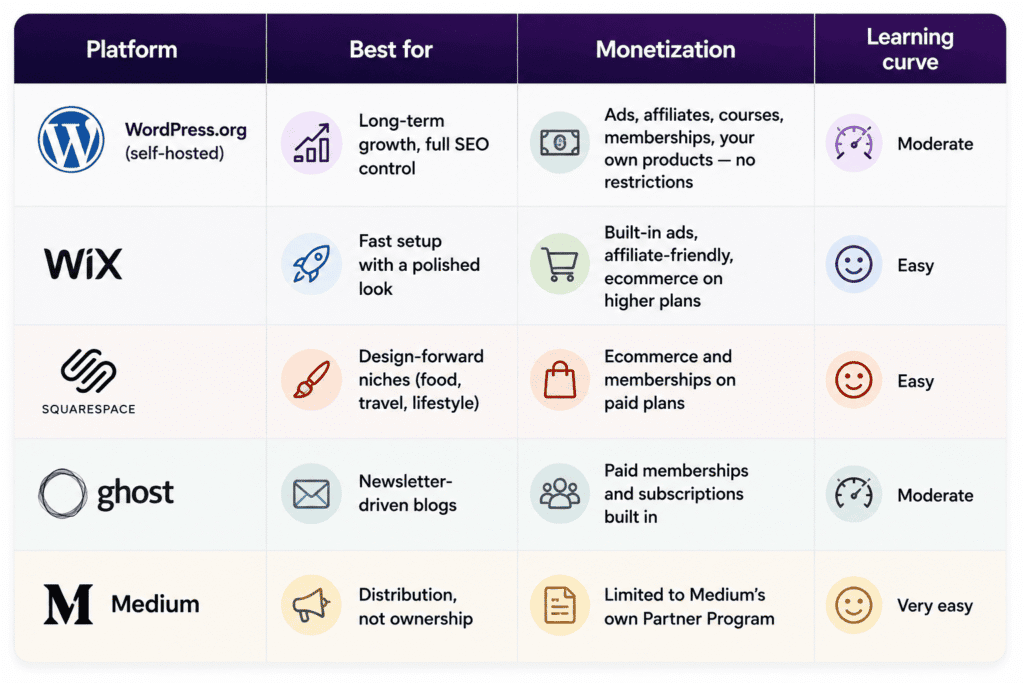
WordPress.org remains the platform most experienced bloggers recommend for anyone serious about turning a blog into income. It’s self-hosted (you’ll need cheap hosting, often $3–$10 a month to start), which means you own your content outright and can add any ad network, affiliate plugin, or digital storefront without asking permission. It also gives you the deepest control over technical SEO — page speed, schema markup, internal linking — which matters more, not less, now that AI search tools reward clearly structured, fast-loading pages.
Wix and Squarespace trade some of that flexibility for speed and design. If you want to publish your first post this weekend without touching code, either is a reasonable starting point, especially for visual niches like food, travel, or home design. Just know that migrating away later, if you outgrow the platform, is more work than it would be from WordPress.
Ghost has become a popular choice for bloggers whose plan is to build a paid newsletter or membership from day one, since subscriptions are built into the platform rather than bolted on.
Medium is worth mentioning because it’s genuinely one of the easiest ways to publish, but it’s better treated as a distribution channel than a home base — you don’t own your audience or your monetization options there the way you do on a self-hosted site.
If you want the single most future-proof answer to “best platforms to start a blogging side hustle with easy monetization,” it’s WordPress.org paired with a beginner-friendly host — you get the ownership and SEO control of a full website with a setup process that’s genuinely doable in an afternoon.
Step-by-Step Guide to Setting Up a Profitable Blog as a Side Hustle
Here’s a practical, no-fluff path from zero to a published, monetizable blog.
Step 1: Pick a Niche and a Specific Reader
Don’t just pick “finance.” Pick “budgeting for new parents on one income” or “debt payoff for freelancers.” A specific reader makes every future decision — topics, tone, products to recommend — much easier.
Step 2: Choose Your Platform and Register a Domain
Go with self-hosted WordPress if you want long-term flexibility, or Wix/Squarespace if speed matters more right now. Pick a short, memorable domain name that doesn’t box you into one narrow topic forever.
Step 3: Set Up Hosting and the Essentials
Budget hosts start around $3–$5 a month for a new blog. Install your theme, set up basic pages (About, Contact, Privacy Policy, Disclosure), and connect Google Search Console and Google Analytics from day one so you can track growth.
Step 4: Plan Your First 20–30 Articles Around Real Search Intent
Before you write a single post, build a list of 20–30 topics your target reader is actually searching for. Use free tools like Google’s “People also ask” boxes, Google Trends, and Reddit threads in your niche to confirm real demand — not just topics you find personally interesting.
Step 5: Write Original, Experience-Based Content
This is the step that separates blogs that rank from blogs that don’t. Add details AI can’t invent: your own numbers, your own photos, your own mistakes and results. Aim for genuinely useful, specific posts rather than padded, generic ones — a tightly written 1,200-word post that actually answers the question usually outperforms a bloated 3,000-word post that doesn’t.
Step 6: Build an Email List From Post One
Add a simple opt-in (a checklist, template, or mini-guide) to your very first posts. Email subscribers are the one audience you fully own — they don’t disappear if a search algorithm update hits, and blogs with an active list tend to earn several times more per visitor than blogs without one.
Step 7: Publish Consistently and Promote Beyond Google
Bloggers who publish multiple times a week and show up outside of search — Pinterest, a newsletter, short-form video, niche Facebook groups or forums — report stronger, more resilient results than those relying on Google alone. Consistency compounds; a blog with 100 solid posts and steady output almost always beats one with 20 posts and long gaps.
Step 8: Turn On Monetization as Traffic Grows
Start with affiliate links relevant to your content (tools and products you’d genuinely recommend), then add display ads once you clear the traffic minimums most premium ad networks require. Layer in a simple digital product — a template, guide, or mini-course — once you understand what your readers actually want.
Step 9: Track Everything Like a Business
Revenue, expenses, traffic, and hours worked. Treating your blogging side hustle like a real small business — not a hobby — is one of the most consistent habits among bloggers who eventually go full-time.
Top Tools to Grow Traffic for a Blogging Side Hustle
Traffic is the fuel behind every blogging side hustle, and the tool landscape has shifted quite a bit as AI-powered search has grown alongside traditional Google results. A realistic toolkit covers three jobs: finding what to write, making sure it’s structured to rank, and tracking what’s actually working.
For keyword and topic research:
- Google Search Console (free) — shows exactly which queries are already bringing you traffic, which is often the fastest way to find your next winning post.
- Google Keyword Planner (free) — solid starting point for search volume, especially for beginners not ready to pay for a full SEO suite.
- Ahrefs or Semrush (paid) — the deeper, more comprehensive option once your blog has enough traffic to justify the cost; useful for competitor research and backlink tracking.
For content structure and on-page SEO:
- Surfer SEO or Frase — generate content briefs based on what’s actually ranking, helping you structure headings and cover subtopics competitors miss.
- Screaming Frog (free tier available) — crawls your site to catch broken links, missing tags, and other technical issues that quietly hurt rankings.
For AI and generative search visibility (GEO/AEO):
As AI Overviews and chatbot answers pull from more source pages, a newer category of tools has emerged specifically to track how often a site gets cited inside AI-generated answers, not just traditional blue links. These tools are optional for beginners but worth exploring once your blog has real traffic, since being the source an AI tool quotes can still send meaningful referral clicks.
For distribution and list-building:
- Pinterest — still one of the highest-converting free traffic sources for niches like food, home, finance, and lifestyle.
- An email platform (ConvertKit, MailerLite, or similar) — for building and nurturing the list you fully own.
- Canva — for the pins, graphics, and social images that support promotion without hiring a designer.
The mistake to avoid is tool-hopping. Most successful blogging side hustles run on two or three tools used consistently — a free analytics setup, one content-planning tool, and one distribution channel — rather than a dozen subscriptions nobody has time to actually use.
How Much Can You Actually Earn? Monetization and Realistic Timelines
There’s no single number for how much a blogging side hustle pays, because income depends heavily on niche, traffic, and how many income streams you run at once. That said, a few patterns show up consistently across income surveys and case studies:
- Display ads typically start paying once a blog clears a traffic threshold required by premium ad networks — often somewhere in the 10,000–50,000 monthly pageviews range, depending on the network.
- Affiliate marketing tends to be the single largest income source for bloggers earning solid part-time or full-time income, often outperforming ads once a blog has built reader trust.
- Digital products (templates, guides, mini-courses) carry far higher margins than ads or affiliates because there’s no middleman taking a cut — many experienced bloggers eventually shift more of their income here.
- Sponsored content and services (consulting, freelance writing, coaching) can supplement income earlier, before traffic is high enough for ads or affiliates to pay meaningfully.
Realistically, most blogging side hustles don’t produce meaningful income in the first six months. A smaller share of bloggers do see early traction — often because they’ve picked an underserved niche or already have some audience or expertise to draw on. The more common pattern is slow, compounding growth: a modest amount by year one, meaningfully more by year three, and — for the bloggers who stick with it — a genuine income replacement somewhere in the four-to-ten-year range. That timeline isn’t exciting to hear, but it’s a far more honest starting point than the “passive income in 90 days” pitch you’ll see elsewhere.
Mistakes That Kill a Blogging Side Hustle (Avoid These)
A few patterns show up again and again in blogs that stall out:
- Picking a topic that’s too broad. A blog about “everything” competes with everyone and stands for nothing. Niching down, even uncomfortably narrow at first, makes ranking and monetizing far easier.
- Publishing inconsistently, then giving up. Bloggers who post regularly — even just once or twice a week — report meaningfully better results than those who post in bursts and then disappear for months.
- Ignoring email from the start. Waiting until traffic is already high to start building a list means missing months (or years) of subscribers you’ll never get back.
- Relying on Google alone. A blog with only one traffic source is one algorithm update away from a crisis. Pinterest, a newsletter, or a modest social presence acts as insurance.
- Chasing ad revenue before affiliate or product income. Ads usually need high traffic to pay well; affiliate links and digital products can earn from a much smaller, more engaged audience.
- Publishing generic, AI-only content with no personal experience. Search engines and readers alike increasingly reward specificity — your own data, photos, and results — over rewritten summaries of what’s already ranking.
Frequently Asked Questions
Is blogging still a good side hustle in 2026?
Yes, for people willing to treat it as a slow-building small business rather than a quick side gig. Competition and AI-driven search have changed how blogs get discovered, but specific, well-researched, experience-based content still ranks and still earns.
How much do bloggers actually make per month?
It varies enormously. Many blogs earn little to nothing, especially in the first year or two, while blogs that survive five-plus years often reach a few thousand dollars a month, and a smaller group of established bloggers earn well into five or six figures monthly. Niche, traffic, and number of income streams all matter more than any single “average” figure.
How long does it take to make money blogging?
Research on blogging income suggests it typically takes close to two years to start earning anything meaningful, and roughly four years, on average, to reach a full-time income — though consistent publishers in strong niches sometimes move faster.
Do I need to be a great writer to start a blogging side hustle?
No. Clear, useful, and specific writing beats polished prose every time in this space. Readers and search engines both reward content that actually answers the question and includes real experience over content that just sounds impressive.
What’s the best platform for a beginner starting a blogging side hustle?
Self-hosted WordPress.org offers the most long-term flexibility and monetization control, while Wix or Squarespace suit anyone who wants a faster, more visual setup. Either is a reasonable starting point — the platform matters far less than consistent publishing.
How much does it cost to start a blogging side hustle?
A basic setup — hosting, a domain, and a theme — can cost as little as $3–$10 a month to start. Most of the real investment in a blogging side hustle is time, not money, at least in the first year.
Can I use AI tools to run a blogging side hustle?
Most professional bloggers now use AI somewhere in their process, typically for outlining, editing, or brainstorming. The blogs that keep ranking tend to use AI as an assistant rather than the sole author, adding personal experience, original data, or firsthand testing that AI alone can’t produce.
Is blogging still worth it with Google’s AI Overviews taking more clicks?
AI Overviews have changed how much traffic goes to any single result, but they haven’t erased the opportunity — specific, trustworthy content still gets cited and clicked. Diversifying traffic sources (email, Pinterest, social) reduces how much any single search change can hurt your income.
Final Thoughts
A blogging side hustle isn’t a shortcut, and anyone promising fast, passive income from it is skipping the part where real bloggers spend months writing into what feels like silence before traffic and income start to build. But the data is also clear that patient, consistent bloggers — the ones who pick a specific niche, publish real experience instead of recycled advice, and diversify beyond Google and beyond ads — do build something that pays off, often for years after the work is done.
If you’re weighing whether to start, the honest answer is this: pick a niche you can write about for two years without getting bored, choose a platform that won’t box you in later, and publish your first article this week instead of researching for another month. The bloggers earning real income right now aren’t the ones who found a secret. They’re the ones who started when everyone else was still deciding.