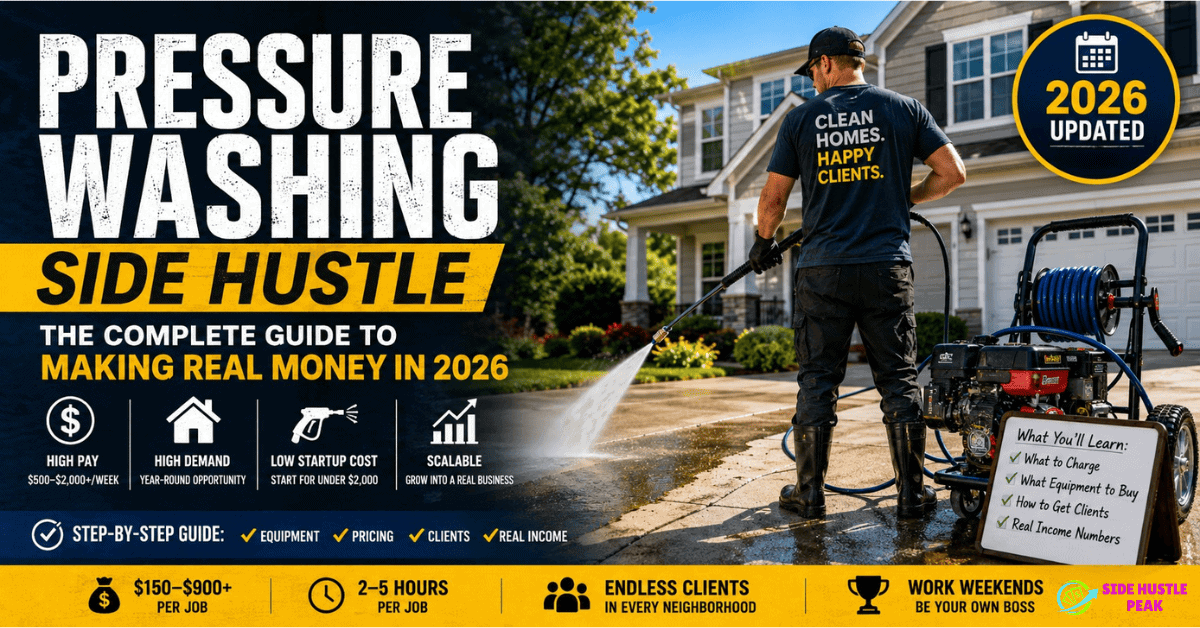
You might be surprised by this number: A single pressure washing operation on a deck, driveway, and house exterior can earn between $400 and $900 in a single afternoon. That’s not an exaggeration or a best-case outlier. That’s what professionals are quoting and getting paid right now across neighborhoods in every state in the US.
And here’s what makes it even more interesting: the equipment to do that job costs less than a single month’s car payment.
The pressure washing side hustle has quietly become one of the most talked-about ways to earn serious extra money in 2026 — and for good reason. It’s physical, it’s visible, it delivers instant results that clients love, and it runs on demand that doesn’t slow down. Homeowners are spending more on curb appeal and home maintenance than ever. The US home improvement market crossed $466 billion in 2025, and a growing chunk of that is exterior cleaning.
This is the complete guide to starting a pressure washing side hustle in 2026 — what gear to actually buy, what to charge, how to get your first clients, and what the real income numbers look like when you’re honest about it.
Is a Pressure Washing Side Hustle Actually Worth It?
Before spending a dollar on equipment, let’s answer the question directly: yes, it’s worth it — but with the right expectations.
Power washing is one of the most profitable and satisfying side hustles you can start. With relatively low startup costs, high hourly rates, and strong demand during spring and summer months, it offers an excellent opportunity to build meaningful income while maintaining your regular job.
The math is genuinely compelling. A pressure washing side hustle typically generates $50 to $150 per hour depending on your equipment efficiency and local market conditions. In practice, a solo operator running a clean weekend route of 2–3 jobs can bring in $600–$1,500 in a single Saturday.
Part-time pressure washing operators commonly earn $3,000–$4,000 per month, and many break even on their startup costs after just one or two jobs. That kind of return-on-investment is rare in the side hustle world.
The honest caveat: this isn’t passive income. You’re doing physical outdoor work, dealing with equipment, and chasing clients at first. But if you’re willing to put in the work during peak season, the financial payoff is hard to match.
What Are You Actually Doing?
The business model is straightforward: customers pay you to use high-pressure water (and sometimes specialized cleaning solutions) to clean surfaces around their property — driveways, siding, decks, patios, fences, gutters, and commercial sidewalks. You show up, you clean, they pay. The results are visible and immediate, which means clients are happy, tips happen, and referrals follow.
The pressure washing industry has evolved significantly — modern exterior cleaning is increasingly a chemical application business, using sodium hypochlorite and surfactants at lower pressure to kill organic growth like mold and algae rather than simply blasting surfaces. This approach, called soft washing, reduces liability from surface damage while delivering longer-lasting results.
You don’t need to master soft washing from day one, but understanding the difference between high-pressure washing and soft washing will help you avoid the most common beginner mistake: using too much pressure on the wrong surface and damaging a client’s property.
How Much Can You Earn From a Pressure Washing Side Hustle?
Let’s break down what the market is actually paying right now:
What Clients Pay Per Job
In 2026, pressure washing jobs are typically priced between $150 and $500, with most residential cleanings landing around $250–$400.
Here’s a more detailed breakdown by job type:
| Job Type | What Client Pay | Typical Time |
| Driveway (2-car, ~600 sq ft) | $125–$250 | 45–75 min |
| Deck or patio | $100–$300 | 1–2 hours |
| House exterior washing | $250–$700 | 1.5–3 hours |
| Fence (per linear foot) | $0.50–$2.00/ft | Varies |
| Full property bundle | $400–$900+ | 3–5 hours |
| Commercial sidewalk | $200–$800+ | 2–6 hours |
A typical residential job lands between $180 and $650, with whole-house washing often running $250 to $700 and driveways around $120 to $350.
What You Take Home
Your actual profit depends on operating costs: fuel, cleaning chemicals, equipment depreciation, and your time getting to and from jobs. A realistic net profit margin for a lean solo operation runs 60–75% of gross revenue. Here’s what that looks like in practice:
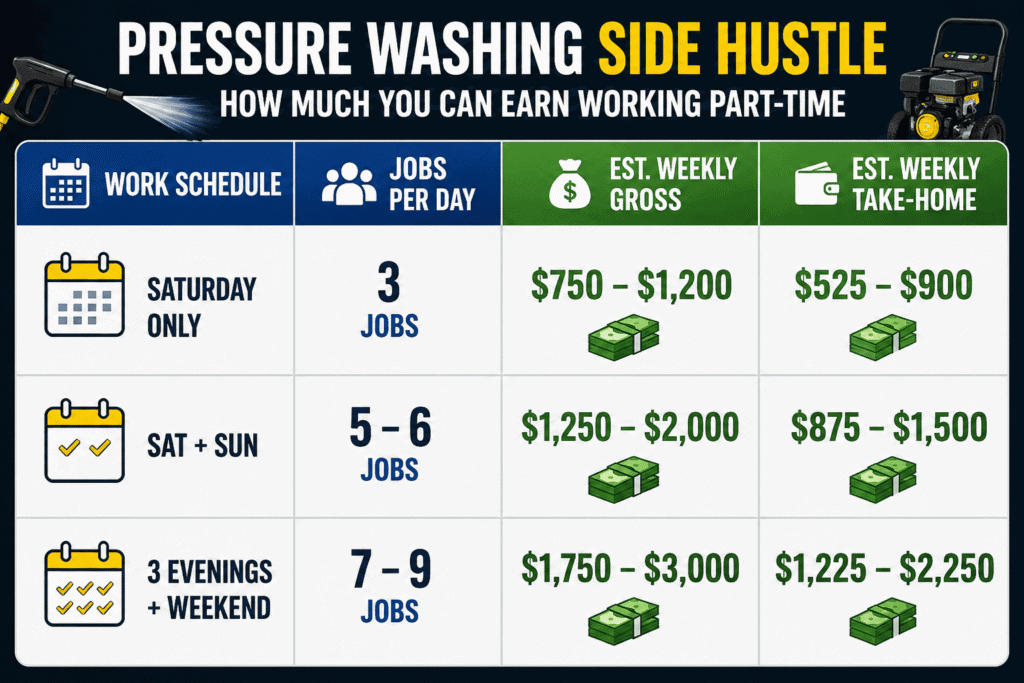
During spring and summer peak season, consistent weekend operators regularly clear $2,000–$3,500 per month working part-time alongside a full-time job.
What Equipment Do You Actually Need?
This is where a lot of beginners either overthink it or underspend in ways that hurt them. Here’s the honest breakdown.
The Pressure Washer Itself
A good pressure washer costs $500–$15,000 depending on whether it’s gas or electric and how powerful it is. Accessories like hoses, nozzles, and surface cleaners add $300–$1,000.
For a side hustle, you don’t need the $15,000 rig. But you also shouldn’t start with a $150 consumer unit from Home Depot. Here’s the practical guide:
For Beginners (Starting Out):
- A gas-powered machine, 3,000–3,500 PSI, 2.5–3.5 GPM hits the sweet spot for residential work
- Budget: $400–$800 for a quality unit from brands like Simpson, Sun Joe (commercial line), or Generac
- This handles driveways, decks, patios, and house siding effectively
Step Up When You’re Ready:
- A 4 GPM or higher gas machine lets you work faster — a 4 GPM machine can wash a 2,500 sq ft house in 1.5–2 hours
- Budget: $800–$1,500
- Brands like Pressure Pro and Simpson have solid commercial-grade options in this range
What to Avoid:
- Don’t buy an electric pressure washer for regular gig work — they’re fine for home use but lack the consistency and power for commercial use
- Don’t buy on Amazon without reading reviews carefully — many budget units fail after 5–10 hours of heavy use
The Essential Accessory Kit
Beyond the machine itself, these items are non-negotiable:
- Surface cleaner attachment ($60–$150): This is the disc-shaped spinning head that cleans flat surfaces like driveways and patios in half the time, with better results. Buy this before your first job.
- Extension wand ($30–$80): Lets you reach second-story siding and gutters without a ladder
- Nozzle set ($20–$40): You need multiple nozzles (0°, 15°, 25°, 40°, and soap nozzle) for different surfaces and pressures
- 50-foot reinforced hose ($40–$80): The hose that comes with most machines isn’t long enough for real jobs
- Downstream injector ($15–$30): Lets you apply cleaning solutions through the machine without a separate pump
Realistic starter kit total: $700–$1,200 including machine and accessories.
Cleaning Chemicals
For most residential work, you’ll use a diluted sodium hypochlorite (bleach) solution mixed with a surfactant. You can buy commercial-grade SH at local pool supply stores or online — it’s dramatically cheaper than retail bleach and far more effective. Budget $30–$60/month for chemicals at normal volume.
Startup Cost Breakdown
Depending on your setup, starting a pressure washing business can cost anywhere from $2,000 to $15,000. Larger operations with cutting-edge vehicles and equipment can cost more than $25,000. But for a lean side hustle — not a full business — here’s what a real starter setup looks like:
| Item | Budget Range |
| Gas pressure washer (3,000–3,500 PSI) | $450–$800 |
| Surface cleaner + nozzle set + wand | $120–$270 |
| Hoses and fittings | $50–$100 |
| Cleaning chemicals (first 2 months) | $60–$100 |
| General liability insurance (annual) | $300–$600 |
| Business cards + door hangers (marketing) | $50–$100 |
| Total | $1,030–$1,970 |
Most operators recover this investment in 2–4 jobs. That’s not a typo. At $350–$500 per job, your equipment pays for itself in a single weekend if you work it.
A note on insurance: don’t skip it. General liability insurance protects you if you accidentally damage a client’s property — a cracked window, damaged siding, or a slip-and-fall incident. It costs $300–$600 per year for a solo operator and is worth every dollar. You won’t get repeat clients or referrals if something goes wrong and you’re not covered.
How to Price Your Work
Pricing is where most beginners leave money on the table by starting too low and struggling to raise rates later. Here’s how to price with confidence from day one.
The Two Main Pricing Methods
Flat Rate Per Job (Most Common)
Based on what you see during a brief walkthrough, provide a fixed pricing for the complete job. This is what most clients prefer because they know exactly what they’re paying. It rewards you for working efficiently.
Square Footage Pricing
Square footage pricing is most common for driveways, decks, and flat surfaces. Charge $0.10–$0.30 per square foot depending on surface type and condition. For fences and gutters, $0.50–$2.00 per linear foot is standard.
Practical Pricing Reference
Use these as your starting point, not your ceiling:
- 2-car driveway → $125–$200
- Deck under 400 sq ft → $100–$200
- House siding wash (1,500 sq ft home) → $250–$400
- House + driveway bundle → $350–$550
- Full exterior package (house + drive + deck + walkways) → $500–$900
- Commercial sidewalk (per 1,000 sq ft) → $80–$200
How to quote: Walk the property, estimate your time, multiply by your target hourly rate (start at $80–$100/hour if you’re new, move to $120–$150 as you build experience and reviews), and give a flat number. Round to the nearest $25. Don’t nickel-and-dime on small extras.
The Upsell That Most People Miss
After washing a driveway, offer to apply a concrete sealer. This takes 15–20 minutes and costs you $30–$50 in materials. You can charge $75–$150 for it. That’s an extra $50–$100 profit added to almost every driveway job — and clients love the “protected” finish.
How to Get Your First 10 Clients
Getting your first few clients is genuinely the hardest part. Once you have 5–10 happy customers and a few solid reviews, referrals start flowing and the business largely runs itself. Here’s exactly how to get there.
Strategy 1: The Free or Discounted First Job
Pick a neighbor or family member with a visibly dirty driveway. Wash it for free or at a steep discount — take before and after photos. This accomplishes two things: you get real practice on real surfaces, and you have proof of your work that you can show everyone else. One good before/after photo on Nextdoor or a neighborhood Facebook group routinely generates 5–15 inquiries in active communities.
Strategy 2: Nextdoor and Neighborhood Facebook Groups
These are the highest-converting platforms for local service businesses. Post your before/after photos with a simple message: “I just started a pressure washing service in [neighborhood name]. $150 to clean a driveway, $80 to do a patio. DM me if you’re interested.” Don’t use corporate language. Write like a neighbor, not a business.
Strategy 3: Door Hangers in Your Target Neighborhood
Print 200–300 door hangers ($40–$60 from Vistaprint or GotPrint) and walk them through neighborhoods with older homes — properties with visibly stained driveways, algae-covered siding, or weathered decks. A 1–2% response rate on 300 door hangers gives you 3–6 calls. From 6 calls, you close 3–4 jobs. That’s $600–$1,200 from a $50 investment.
Strategy 4: TaskRabbit and Angi
TaskRabbit and Angi both have categories for pressure washing. Creating a profile on both platforms gives you instant access to local customers who are actively searching for this service. You’ll pay a referral fee or a lead cost, but when you’re starting out and building reviews, the tradeoff is worth it. Move clients to direct booking once they’ve hired you once.
Strategy 5: Google Business Profile (Takes 10 Minutes, Pays for Months)
Set up a free Google Business Profile for your pressure washing side hustle. When people in your area search “pressure washing near me” or “pressure washing [your city],” your listing has a chance to appear. Add your before/after photos, service list, and start collecting reviews from every client you complete a job for. This is how the busiest operators in any market build a pipeline of inbound leads without paying for ads.
What Surfaces Can You Wash? (And What to Avoid)
Safe and High-Demand:
- Concrete driveways and sidewalks
- Asphalt driveways (lower pressure — 1,200–1,500 PSI max)
- Wood decks (use low pressure + wood cleaner)
- Vinyl and aluminum siding (use soft wash method)
- Brick and stone patios
- Fences (wood, vinyl, chain-link)
- Commercial parking lots and walkways
Proceed With Caution:
- Painted surfaces — always test a small area first
- Older stucco or EIFS siding — easy to damage if you’re not careful
- Roofs — require special soft wash training and different insurance. Don’t start here.
- Windows — low-pressure only; high pressure can crack seals and push water inside
Avoid Until Experienced:
- Soft wood like cedar or redwood — can splinter under high pressure
- Older homes with lead paint — requires EPA compliance and special handling
- Solar panels — specialized service with liability implications
The EPA Rule Every Beginner Misses
This is important and most guides skip it: in the United States, you cannot allow pressure washing runoff containing cleaning chemicals (especially bleach-based solutions) to enter storm drains. This is tightly regulated by the EPA under the Clean Water Act.
For residential work where runoff flows onto grass and soil, you’re generally fine. For commercial work near storm drains, parking lots, or any impervious surface draining directly to a drain, you’ll need a runoff containment plan. This can be as simple as berms and a wet-vac recovery setup for smaller jobs.
This isn’t meant to scare you — most basic residential side hustle jobs are completely fine. But knowing this rule before you get a call from a homeowner with a driveway next to a storm drain will save you a headache.
When Is Pressure Washing Season? (And How to Earn Year-Round)
Peak season for pressure washing runs from March through October in most parts of the US. Spring cleaning drives the heaviest demand, summer stays consistently busy, and fall provides a final push before winter. In warmer climates, this is genuinely a year-round business.
How to maximize income by season:
Spring (March–May) — Your Best Season
This is when homeowners emerge from winter and look at their green-stained driveways, dirty siding, and grim decks with fresh horror. Lead with spring cleaning messaging in your marketing. “Get your home ready for summer” resonates hard in March and April.
Summer (June–August) — Steady and Strong
Deck maintenance, pre-party cleanups, and ongoing driveway work keep the schedule full. This is also the best time to pursue commercial clients — restaurants with outdoor seating, apartment complexes prepping for residents, and retail locations all need regular exterior cleaning.
Fall (September–October) — The Second Wave
Fall is another strong push. “Pre-winter cleanup” and “prep your property before the holidays” messaging works well. Gutter cleaning is a natural add-on service during fall that pairs easily with exterior washing.
Winter (November–February) — Warm Climate Advantage
In Florida, Texas, California, Arizona, and other warm-weather states, pressure washing runs year-round with minimal slowdown. In northern states, this is your off-season — use it to build your online presence, get insurance sorted, and plan your spring marketing push.
Pressure Washing vs. Other Physical Side Hustles
People often compare pressure washing to lawn care, window cleaning, and mobile car detailing. Here’s an honest comparison:
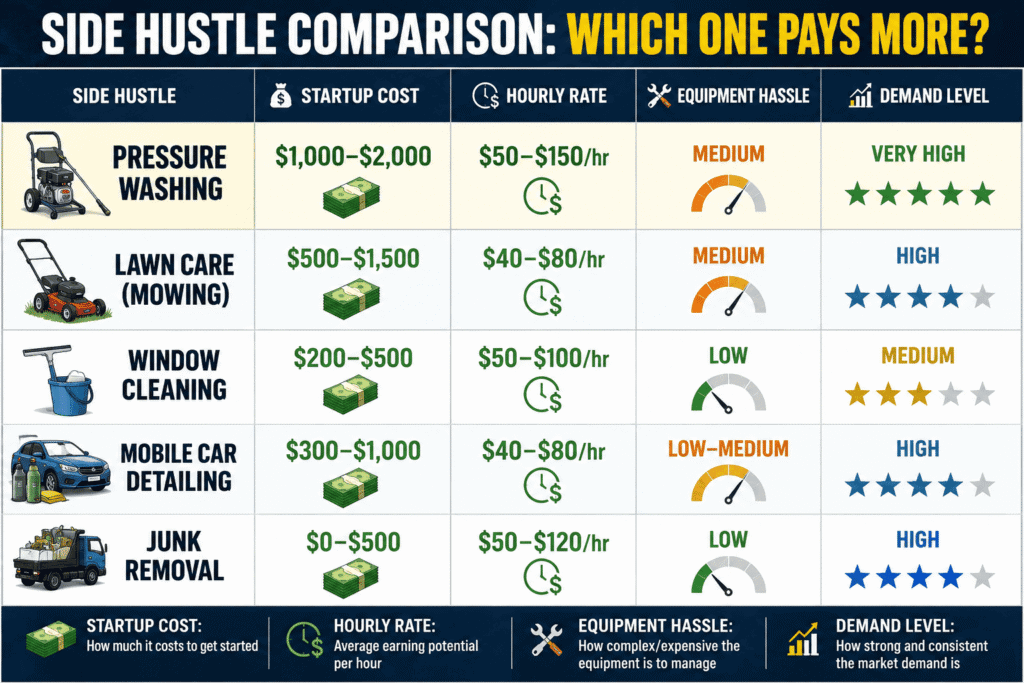
Pressure washing wins on the income ceiling and demand. The startup cost is higher than window cleaning but comparable to lawn care — and the per-job revenue is typically higher than either.
How to Scale From Side Hustle to Real Income
Most people start pressure washing to earn a few hundred extra dollars per month. Some discover they can make far more than that and start thinking bigger. Here’s the natural progression:
Phase 1 — The Side Hustle ($500–$2,000/month)
2–4 jobs per weekend, working Saturday and Sunday. Your equipment fits in the trunk of your car or a small truck bed. You’re doing everything yourself.
Phase 2 — The Serious Side Hustle ($2,000–$5,000/month)
You’ve got a regular client base, referrals are coming in, and you’re doing 8–12 jobs per week during peak season. You’ve added a larger machine and maybe a trailer. You’re earning more from this on weekends than many people make at their full-time job.
Phase 3 — The Business ($5,000–$15,000+/month)
You hire a part-time helper, take on commercial contracts (apartment complexes, HOAs, retail centers), and this is no longer just a side hustle. The average pressure washing business earns a median of $50,000 in annual gross revenue, with more successful operations reaching $100,000 to $200,000 annually. Many operators who start here at Phase 1 reach Phase 3 within 12–18 months.
People Also Ask: Pressure Washing Side Hustle
Is pressure washing a good side hustle in 2026?
Yes — it’s one of the best physical side hustles available. The combination of low startup costs, high per-hour earnings, and strong year-round demand makes it genuinely compelling. If you’re willing to do physical outdoor work, the income potential is hard to beat with any app-based side gig.
How much can I make pressure washing on weekends?
Working just weekends — two days, 3–5 jobs per day — you can realistically earn $600–$1,500 per weekend during peak season. Over a full spring-through-fall season, that adds up to $8,000–$20,000 in extra income from weekend work alone.
What equipment do I need to start a pressure washing side hustle?
At minimum: a gas-powered pressure washer (3,000 PSI or higher), a surface cleaner attachment, a nozzle set, a 50-foot hose, and basic cleaning chemicals. Budget $700–$1,200 for a complete starter kit that will handle any residential job.
Do I need a license or permit to pressure wash as a side hustle?
Requirements vary by state and city. In most US states, a general business license ($50–$150) is sufficient for residential work. Some states require a contractor’s license for commercial jobs above a certain dollar value. Always check your specific local rules. General liability insurance is not legally required in most states but is strongly recommended.
What’s the difference between pressure washing and soft washing?
Pressure washing uses high-pressure water (2,000–4,000 PSI) to physically blast dirt off surfaces. Soft washing uses lower pressure combined with chemical solutions (primarily diluted bleach and surfactants) to kill and remove mold, algae, and organic growth. Soft washing is better for house siding, roofs, and delicate surfaces — it produces longer-lasting results with less risk of surface damage.
How do I find clients for pressure washing?
The fastest methods are Nextdoor and neighborhood Facebook groups (post before/after photos), door hangers in targeted neighborhoods, a Google Business Profile, and platforms like TaskRabbit and Angi. Once you have 5–10 happy clients, word-of-mouth referrals do most of the work.
Can I start pressure washing with no experience?
Yes — the learning curve is relatively short. Spend a few hours watching tutorial videos focused on PSI settings, nozzle selection, and surface cleaner use before your first job. Practice on your own driveway or a family member’s property first. The most important skill is learning what pressure is appropriate for each surface type to avoid damage.
Final Words
Pressure washing is one of those side hustles that sounds almost too simple to be worth serious money — until you run the numbers. A few hours on a Saturday, a machine you can buy for under $1,000, and access to areas full of people who actually want this service done.
The market is there. The demand is real. The equipment cost is low enough that two or three jobs covers it entirely. And unlike an app-based gig where an algorithm controls your earnings, a pressure washing side hustle is a business you own, with income that scales directly with how much effort you put in.
If you’ve been thinking about it, June is arguably the best possible time to start. Peak season is in full swing. Homeowners are home for summer. Driveways, decks, and patios that sat through spring are ready to be cleaned. You could have your first paying client this weekend.
Start now. Not next month.
Want more side hustle ideas that work in 2026? Check out our guides to the Best Side Hustles in California and Side Hustles in Los Angeles for more options across every income level and skill set.